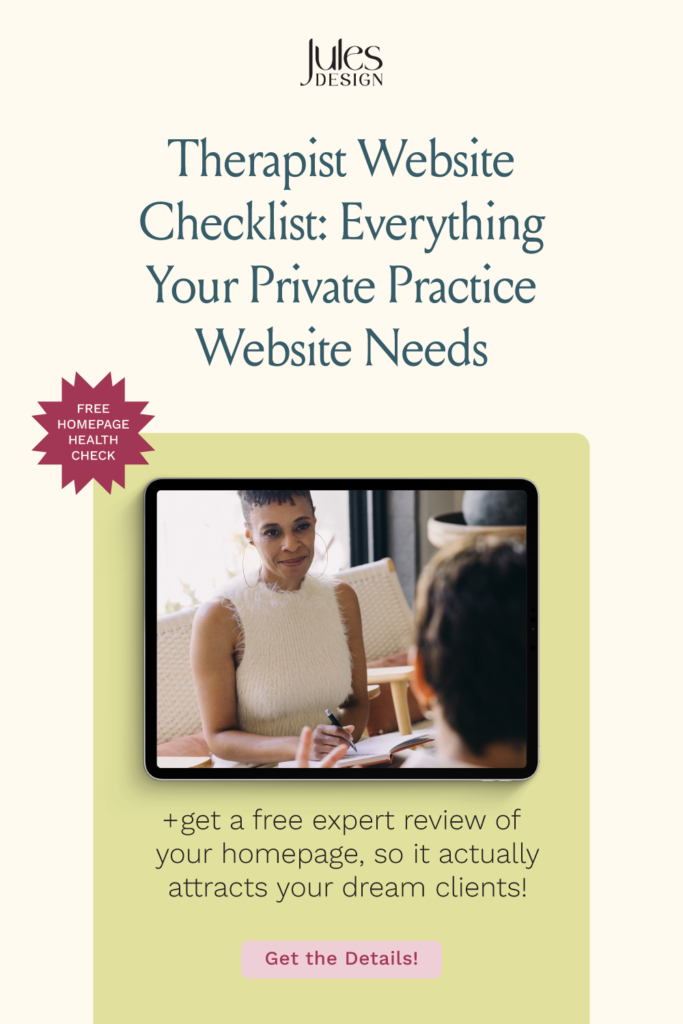
Your website is often the first impression potential clients have of your practice. Before they schedule a consultation or reach out, they’re looking for reassurance that they’re in the right place, and your brand and website play a major role in building that trust.
But what exactly should a therapist website include? I’m here to help!
Whether you’re launching a new private practice or refreshing an outdated site, this checklist will help you create a website that feels professional, builds credibility, and encourages potential clients to take the next step. All while infusing your own unique personality and approach so your website doesn’t feel too clinical.
1. A Clear Homepage That Explains Who You Help
When someone lands on your website, they should immediately understand:
- Who you help
- What challenges you specialize in
- How you can support them
- What to do next
Many therapist websites make the mistake of leading with generic statements like “Helping people live their best lives” or “Welcome to my therapy practice.” While well-intentioned, these phrases don’t provide enough clarity for prospective clients.
Instead, I recommend an “I help” statement at the very top of your website that clearly communicates your specialty and audience.
For example:
“Therapy for busy moms navigating anxiety, perfectionism, and burnout.”
The more specific you can be, the easier it is for the right clients to recognize themselves in your messaging. We want to attract the right people to stick around on your website while allowing the people who aren’t a great fit to leave. Don’t be afraid to niche down and become specialized because this is what will ultimately help you stand out.
2. An About Page That Builds Trust
People want to know who they’ll be working with before they reach out, and why you are the best person to help them.
Your About page should help visitors feel connected to you, while also reinforcing your expertise. While it should certainly include your credentials and approach, the page is actually more about your ideal client than it is about you. I encourage you to go into the why behind your business because this will help potential clients to see themselves in your story.
What to include on your About Page
- Your story or your why
- Your core values
- Your credentials and licensure
- Therapeutic approach
- Areas of specialization
- Professional photos of you
- A personal touch that helps clients feel comfortable
And, a quick reminder: your About page isn’t a résumé or a place to go into every detail about your life story. It’s an opportunity to help prospective clients feel confident taking the next step with you.
3. Services or Program Pages
These are your offerings and how people will ultimately work with you. It can be one service, multiple services, a group program, a membership, a course, an ebook, or anything else you can dream up for your practice.
The important thing here is that each offering should have its own page, and it should be structured as a sales page. This format allows you to go into detail about your offering, your approach, and the results that potential clients can expect from working with you.
For example, if you offer multiple specialties, each should have its own page:
- Anxiety Therapy
- Trauma Therapy
- Couples Counseling
- Teen Therapy
- EMDR Therapy
Dedicated service pages improve both user experience and SEO by allowing you to explain each service in depth and target specific search terms. They also help potential clients quickly find the information most relevant to their situation.
That being said, I do encourage niching down, so offering all of these things… might not be the best approach long-term.
But the same applies if you have multiple offers, but they are all for one niche. If you have a Service, Group Program, and Course, each should be on its own page for the best results.
4. Easy-to-Find Contact Information
One of the biggest reasons potential clients leave a website is because they aren’t sure how to take the next step. So make it easy for potential clients to work with you. Eliminate resistance wherever possible.
Make it easy to contact you by including some of the following:
- A contact page
- A simple inquiry form
- A call scheduler
- Email address
- Phone number (if applicable)
- Location information
- Telehealth availability
5. A Strong Call-to-Action
Every page on your website should guide visitors toward an action, and is something I include on every website that I design.
Ask yourself, what is the number one action you want someone to take? And if they don’t take that action, what would you want them to do instead? Being strategic about where you’re directing traffic is the difference between someone just leaving your website and becoming a lead.
These call to actions are super important for conversions:
- Schedule a consultation
- Book a discovery call
- Contact the practice
- Join the waitlist
- Apply to work with me
- Join my email list (have a freebie here!)
Without a clear call-to-action, visitors may leave without reaching out, even if they’re interested in working with you.
6. Professional Photography
The images on your website have a big impact on how your practice is perceived.
So ask yourself, how do you want your business to look, and who do you want to work with? These are the kinds of questions I ask my clients when we start working together so we can establish a brand identity that truly attracts their ideal client.
My brand identity package includes photo direction, where I will recommend a style of photo for my clients and give examples of what that should look like in the brand guidelines. This helps my clients have a written and visual direction that they can share with a professional photographer to get that look for their own website.
Professional photos help communicate:
- Trustworthiness
- Warmth
- Credibility
- Professionalism
- Personality
I do like to sprinkle in stock photos in my clients’ websites, where needed, but I keep it to a minimum. Whenever possible, use authentic brand photography instead of generic stock photos.
Clients want to connect with the real person behind the practice.
7. Client-Focused Website Copy
Many therapists unintentionally write website copy that focuses heavily on themselves and their expertise. I mentioned this earlier when we were talking about the About page, because that is one of the biggest offenders, but I see this site-wide, too.
Instead, your website should focus on the client and how you will help take them from where they are now to where they desire to be.
So ask yourself these questions when writing your website copy:
- Does my copy speak directly to the client’s challenges?
- Does it explain how I can help them?
- Does it make the next step feel approachable?
The goal is to help potential clients feel seen, understood, and supported so they feel comfortable taking that next step.
I provide my website design clients with a Website Copy Guide to help them craft messaging that builds a connection with their potential clients.
It goes into detail about what sections of copy to include on each page of your website and how to write them in a way that feels authentic and trustworthy. Plus, it includes AI prompts to make the copy creation process as easy and seamless as possible.
My clients love how much time this guide saves, and the results they get in converting curious site visitors into therapy clients.
8. Mobile-Friendly Design
More than half of website traffic comes from mobile devices, so please don’t forget about your mobile (or tablet!) experiences too.
If your website is difficult to navigate on a phone, visitors are likely to leave before reaching out:
Make sure your website:
- Loads quickly
- Has readable text
- Uses clear navigation
- Features easily clickable buttons
- Displays properly on all screen sizes
When I’m working with my therapy clients, I test all website designs on mobile and tablet views to make sure everything looks good and is optimized for that unique viewpoint. I also do cross-browser testing to make sure the website works seamlessly on different browsers.
Then I even take it a step further by doing site speed testing and accessibility testing to make sure the website is built to get my clients the results they deserve. These things not only play into user experience but also into SEO, so it’s important that they are optimized.
9. Search Engine Optimization (SEO)
A beautiful website won’t help if potential clients can’t find it.
This is why I always talk about a marketing strategy with my clients on our kick-off call. I want to understand what kinds of marketing they plan to do so their website can work with that strategy to bring in clients.
One of the best marketing strategies when it comes to your website is SEO, which helps therapists appear in search results when people are looking for services in their area.
At a minimum, your website should include:
- Keyword-rich page titles
- Meta descriptions
- Optimized headings
- Service pages
- Location information
- Internal links between pages
SEO is one of the most effective long-term marketing tools for private practice owners because it helps ideal clients discover your website organically.
I include SEO basics with all of my website design packages so my clients can easily be found online.
I also offer brand support packages after my clients’ websites launch to create an SEO strategy through content creation, landing pages, and active SEO marketing for increased search volume.
10. Testimonials and Media Features
Trust-building elements can help reassure prospective clients that you have the experience to help them.
Social proof from client testimonials is the most impactful thing you can add to your website because it provides a different voice and perspective than your own. However, privacy for your therapy clients is also very important.
That’s why I recommend keeping testimonials anonymous for many therapists. Focus on the feeling or results your clients experience, rather than what they are going through specifically.
Examples of Trust Signals:
- Client Testimonials
- Media appearances
- Podcast interviews
- Professional memberships
- Certifications
- Speaking engagements
- Publications
Sprinkle these elements throughout your website to reinforce your expertise and credibility.
Therapist Website Checklist
I know I’ve covered a lot in this post, so how about a little recap? Before launching your website, make sure you have:
✓ A clear homepage message
✓ An engaging About page
✓ Dedicated offering pages
✓ Easy-to-find contact information
✓ Strong calls-to-action
✓ Professional photography
✓ Client-focused messaging
✓ Mobile-friendly design
✓ SEO foundations in place
✓ Credibility-building trust signals
Final Thoughts
A successful therapist website isn’t just about looking professional. It’s about creating trust, clarity in your approach, and connection so they want to work with you.
When potential clients visit your website, they should quickly understand who you help, how you can support them, and what to do next. They should also get a sense of your personality and what makes your practice unique through the design. By focusing on these essential elements, you’ll create a website that not only reflects your expertise but also helps your private practice grow.
If you’re a therapist ready for a website that feels professional, strategic, and designed to attract aligned clients, I’d love to help! Let’s chat about working together.